Thumbnail
Solution Image
Independent Resilient Clip Stud Wall
£0.00
INC VAT
Show VAT
metres
cm
feet
inches
Show extra walls (Wall 2, 3, 4)

Independent Resilient Clip Stud Wall System

  • A high-performance wall soundproofing system built on an independent stud frame
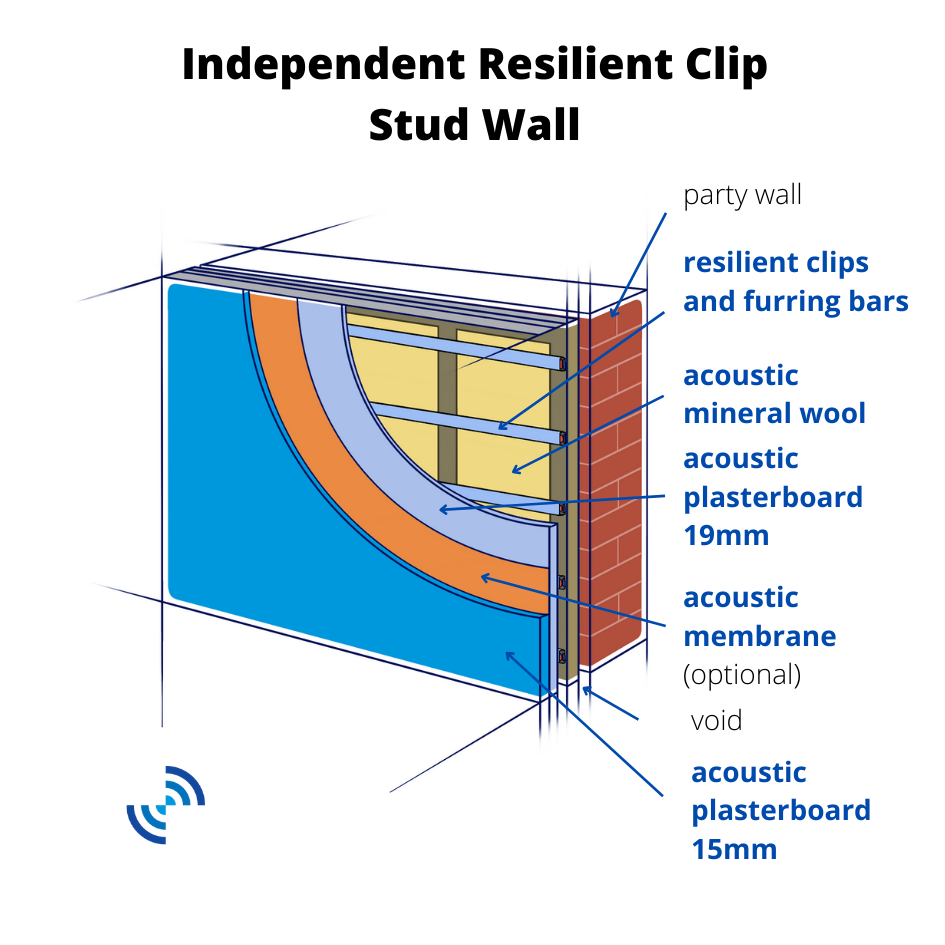
  • Uses resilient clips and furring channels to isolate the acoustic board layers
  • Designed for stronger airborne noise reduction through party walls and separating walls

Our Independent Resilient Clip Wall Solution:

Independent Frame

Separate timber stud wall

Acoustic mineral wool within the cavity

Reduced direct contact with the party wall

This system starts with an independent frame, helping reduce the amount of sound and vibration passing directly from the existing wall into the new acoustic build-up.

Clip & Channel Isolation

Resilient clips fitted to the frame

Furring channels fixed into the clips

Reduced rigid contact points

The resilient clip and channel layer creates separation between the stud frame and the acoustic board layers, helping reduce vibration transfer through the wall.

Acoustic Board Build-Up

19mm Acoustic Plank

Optional Tecsound membrane

15mm dB Board finishing layer

The layered board build-up adds mass to the system, while the optional membrane can be included for extra acoustic density between the board layers.

Acoustic performance can vary depending on the existing wall construction, frame depth, clip spacing, flanking paths and installation quality. For best results, keep the frame independent where possible, avoid rigid bridging and seal all perimeter gaps carefully.

The Independent Resilient Clip Stud Wall system works by building a new timber stud frame in front of the existing wall. This creates a separate structure that helps reduce direct vibration transfer from the original wall.

Rockwool RW3 75mm is fitted within the frame to absorb sound inside the cavity. Resilient clips are then fixed to the frame, with resilient channels fitted into the clips. The acoustic board layers are fixed to the channels, helping isolate them from the frame and improve overall wall performance.

The system uses 19mm Acoustic Plank and 15mm dB Board to add mass. The optional Tecsound membrane can be included between the board layers for additional acoustic density.

This system can be upgraded by including the Tecsound 50SY self-adhesive membrane between the acoustic board layers. This adds extra mass without greatly increasing the wall depth.

For rooms with stronger noise problems, you may also need to consider flanking paths such as floors, ceilings, sockets, adjacent walls and gaps around the perimeter. The best results usually come from treating the full route the sound is travelling through.

This solution is suitable for party walls, separating walls, bedrooms, living rooms, home offices, studios and other spaces where airborne noise is passing through an existing wall.

It is a strong option where you have enough space to build an independent frame and want the added isolation benefits of a resilient clip and channel system.

Install a new timber stud frame in front of the existing wall, keeping it independent where possible. Fit Rockwool RW3 75mm neatly between the studs, avoiding gaps and over-compression.

Fix the resilient clips to the stud frame, then fit the resilient channels into the clips. Install the 19mm Acoustic Plank to the channel system. If using the optional membrane, apply the Tecsound layer between the board layers. Finish with the 15mm dB Board, then seal all perimeter gaps with acoustic sealant.

Take care not to bridge the new wall back into the original structure, as rigid contact points can reduce the acoustic benefit of the system.

Need help with your soundproofing?

Our team are on hand to answer any questions and give you all the advice you need.

Contact us

FAQs

It is a wall soundproofing system built on a new independent stud frame, with resilient clips and channels used to isolate the acoustic board layers.

This helps reduce sound and vibration transfer through the wall structure.

A resilient bar system uses flexible bars fixed to the frame. A clip and channel system uses resilient clips with separate channels, creating a more controlled isolated fixing layer.

The clip and channel method can be a stronger option where extra isolation is needed.

This system is mainly designed for airborne noise through walls, including voices, TV noise, music and general neighbour noise.

If noise is also travelling through floors, ceilings or structural junctions, those areas may need to be considered too.

The Tecsound membrane is optional, but it is useful when you want to add extra mass between the board layers.

If you are dealing with stronger airborne noise, or you want the better-performing version of the system, it is worth including.

The final depth depends on the stud frame size, clip/channel layer and board build-up used.

It takes up more space than a slim direct-to-wall system, but the added depth helps create better separation from the existing wall.

It can be installed by competent DIY users, but it requires careful setting out, framing, clip spacing, channel installation, board handling and acoustic sealing.

If the frame is bridged back to the existing wall or gaps are left around the perimeter, performance can be reduced.

Get 10% Off Your First Order

Sign up today and we’ll send your discount code straight to your inbox.