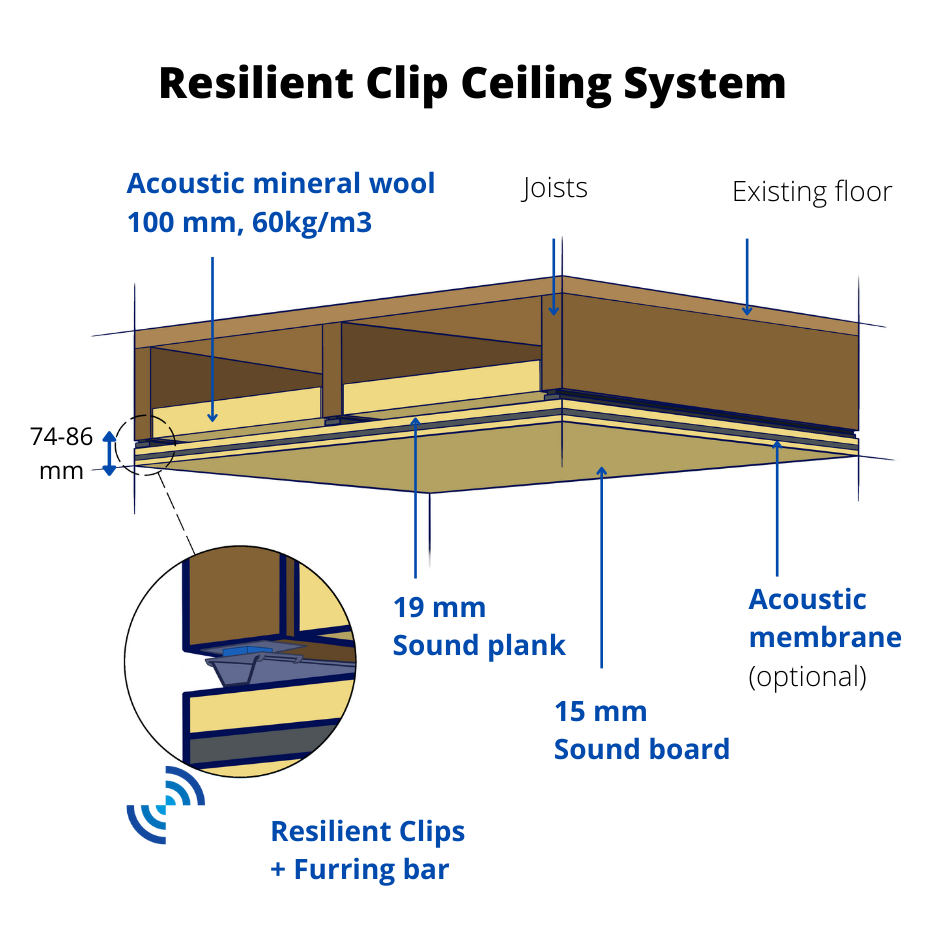
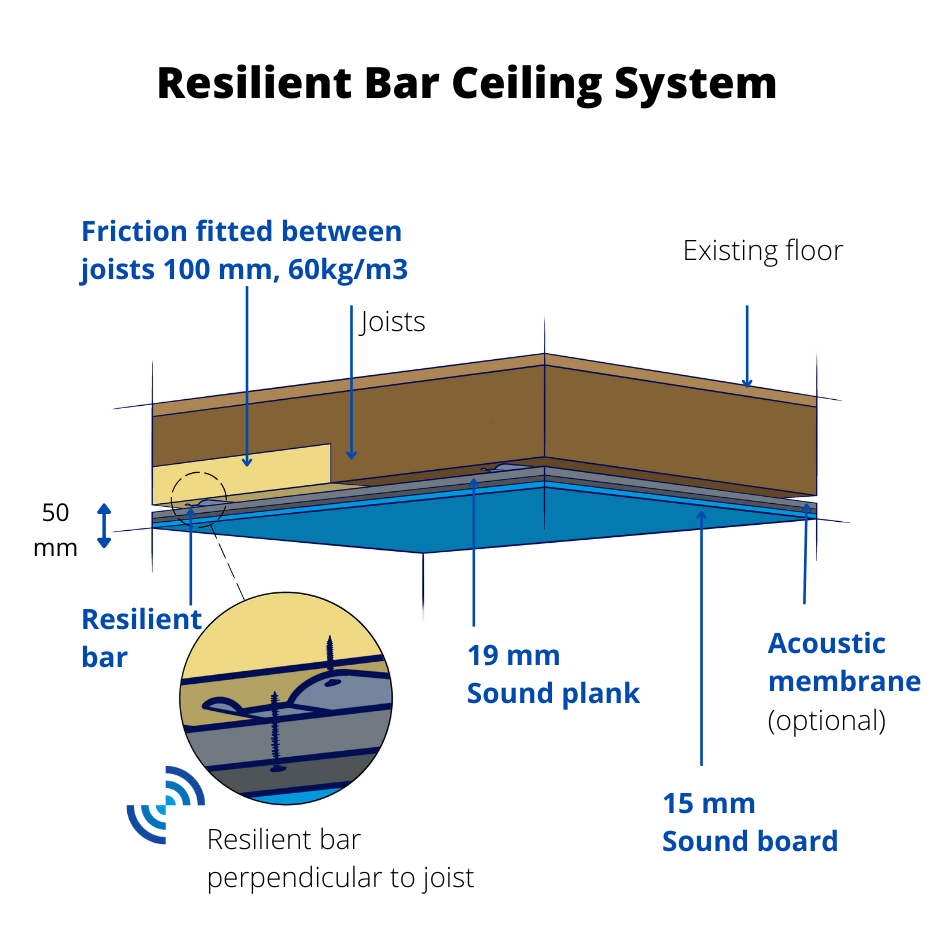
When researching ceiling soundproofing, it can be difficult to know whether you need a resilient bar system, a resilient clip system, acoustic insulation, soundproof boards or a full ceiling build-up. We make it easier to compare the options and choose a solution based on the noise you are trying to reduce.
Ceiling soundproofing can make a major difference when noise is travelling from the room or property above. Whether you are dealing with footsteps, voices, music, TV noise, impact vibration or general movement, choosing the right ceiling soundproofing system is important.
There are several acoustic products used in ceiling systems, including resilient clips, resilient bars, resilient channels, acoustic mineral wool, acoustic plank, soundproofing membranes, dB boards and acoustic sealant. These products work together to reduce sound transfer through the ceiling structure.
Ceiling soundproofing is designed to reduce noise travelling down from above. This can be especially useful in flats, apartments, offices, treatment rooms, studios, bedrooms and any room where sound from the floor above is causing disturbance.
A well-designed ceiling soundproofing system can help reduce both airborne noise and impact noise. Airborne noise includes voices, TV and music. Impact noise includes footsteps, movement, dropped items and vibration travelling through the structure.
Before choosing a ceiling soundproofing system, it is important to understand the type of noise you are dealing with, the existing ceiling structure and the level of sound reduction you need.
Airborne noise includes voices, TV, music and general sound from above. Impact noise includes footsteps, dropped items, furniture movement and vibration. Ceiling soundproofing can help with both, but impact noise is often more difficult to treat unless the floor above is also addressed.
The existing ceiling structure affects the type of system you need. Timber joist ceilings, concrete ceilings and suspended ceilings all behave differently. Timber joist ceilings often benefit from acoustic mineral wool between joists, combined with resilient isolation and dense board layers.
Some ceiling systems are easier to install when the existing ceiling is removed, as this allows acoustic insulation to be fitted between the joists. Other systems may be installed beneath an existing ceiling, depending on the structure and available fixing points.
Ceiling soundproofing systems add depth. A resilient bar system may be more cost-effective and slightly simpler, while a resilient clip and channel system usually provides better isolation but may require more careful installation and additional build-up depth.
Ceiling soundproofing systems work by combining absorption, mass, isolation and sealing. Each part of the system helps reduce the amount of sound passing from the room above into the room below.
Acoustic mineral wool, such as Rockwool RW3, is commonly fitted between ceiling joists. It helps absorb sound energy inside the ceiling cavity and reduces resonance between the floor above and the ceiling below.
Decoupling means reducing direct contact between the new ceiling layers and the structure above. Resilient bars, resilient clips and channels help create an acoustic break, reducing vibration transfer through the ceiling.
Dense layers such as 19mm acoustic plank, soundproofing membrane and 15mm dB board help block airborne sound. Adding mass makes it harder for sound waves to pass through the ceiling system.
Resilient clips and resilient bars help absorb vibration before it reaches the final ceiling layers. Resilient clip systems usually offer stronger isolation than resilient bars because the ceiling lining is more effectively separated from the joists.
Acoustic sealant is used around the perimeter and joints to reduce sound leakage. Even small gaps can reduce the performance of a ceiling soundproofing system, so careful sealing is essential.
A resilient bar ceiling system is a practical and cost-effective option for improving ceiling soundproofing. It helps decouple the new ceiling layers from the joists and can reduce both airborne noise and some impact vibration.
A resilient clip ceiling system is generally the higher-performance option. The clips and channels provide a stronger acoustic break, helping to reduce vibration transfer more effectively than resilient bars. This makes resilient clips better suited to more serious noise issues.
Yes, ceiling soundproofing can help reduce footstep noise from above, especially when resilient clips or resilient bars are used with acoustic mineral wool and dense board layers. However, impact noise is often best treated as close to the source as possible, which means treating the floor above can provide stronger results where access is available.
If you cannot treat the floor above, a high-performance ceiling system can still make a noticeable improvement by reducing vibration transfer and improving the acoustic build-up below.
Some ceiling soundproofing projects may need to meet acoustic standards under Building Regulations, particularly where properties are being converted, separated or used as flats. In the UK, this is commonly linked to Part E, which covers resistance to the passage of sound.
If your project needs to meet a specific acoustic requirement, it is important to confirm the specification before work starts. In some cases, a sound test may be required once the installation is complete.
The best ceiling soundproofing solution depends on the type of noise, the existing ceiling structure, the available ceiling height and the level of performance required. A resilient bar ceiling may be suitable for general noise reduction, while a resilient clip ceiling is usually better for higher-performance projects.
If you are unsure which system is right for your ceiling, speak to our team before ordering. We can help you compare the available options and choose a solution that suits your room, budget and noise issue.
Ceiling soundproofing systems are usually chosen based on the type of noise coming from above, the existing ceiling structure and the level of performance required. Most ceiling systems use acoustic insulation, resilient isolation and dense board layers to reduce sound transfer.
Resilient bar ceiling systems are a practical option for improving ceiling soundproofing. They help separate the new ceiling layers from the joists above, reducing vibration transfer while adding acoustic mass and insulation to the ceiling build-up.
Resilient clip ceiling systems offer a higher-performance approach. The clips and channels provide stronger isolation than resilient bars, making them better suited to more serious airborne noise, impact noise and vibration from the floor above.
Ceiling systems can help reduce footstep and impact noise from above, but the best results are usually achieved by treating the floor above as well. Where floor access is not possible, a resilient clip ceiling system is normally the stronger ceiling-side option.
The Resilient Clip Ceiling System is best for projects where you need a higher level of ceiling soundproofing. It is designed to reduce both airborne noise, such as voices, TV and music, and impact noise from above, such as footsteps and movement.
The system uses resilient clips and resilient channels to isolate the new ceiling layers from the existing joists. This helps reduce vibration transfer and creates a more effective acoustic break than fixing boards directly to the ceiling structure.
This system includes resilient clips, resilient channels, Rockwool RW3 acoustic mineral wool, 19mm acoustic plank, Tecsound 50SY self-adhesive membrane and 15mm dB board.
In most cases, yes. A resilient clip system usually provides a higher level of isolation than a resilient bar system because the new ceiling is better separated from the structure above. This makes it a stronger option for more demanding noise problems.
Yes, it can help reduce impact noise from above, including footsteps and movement. However, the best results are usually achieved when the floor above is also treated, especially where impact noise is severe.
Professional installation is recommended for this system because the clip layout, channel fixing, board layers, acoustic membrane and sealing all need to be installed correctly. Poor fixing or direct contact points can reduce the performance of the ceiling.
The Resilient Bar Ceiling System is a practical ceiling soundproofing option for reducing noise from above. It is commonly used where you want to improve the acoustic performance of a ceiling without using a more advanced resilient clip system.
Resilient bars help decouple the new ceiling layers from the existing joists. The bars create a small acoustic break, helping reduce vibration transfer before sound reaches the final plasterboard layers.
This system includes Rockwool RW3 acoustic mineral wool, resilient bars, 19mm acoustic plank, Tecsound 50SY self-adhesive membrane, 15mm dB board and acoustic sealant.
Yes. The combination of acoustic mineral wool, acoustic plank, Tecsound membrane and dB board helps reduce airborne noise such as voices, TV, music and general sound from the room above.
It can help reduce some impact noise because the resilient bars reduce direct vibration transfer through the ceiling. However, for stronger impact noise reduction, the resilient clip ceiling system is usually the better-performing option.
Choose resilient bars when you want a simpler and more cost-effective ceiling soundproofing system. Choose resilient clips when you need a higher-performance solution for more serious airborne or impact noise from above.
Our team are on hand to answer any questions and give you all the advice you need.
Contact usOur ceiling soundproofing solutions work by combining acoustic insulation, resilient isolation, soundproofing membranes and dense acoustic boards to reduce noise travelling from above. Instead of relying on one product, each ceiling system uses a layered build-up to help reduce airborne noise, impact noise and vibration transfer.
Depending on the solution, this can include Rockwool RW3 acoustic mineral wool, resilient bars, resilient clips, resilient channels, 19mm acoustic plank, Tecsound acoustic membrane, 15mm dB board and acoustic sealant. These materials work together to absorb sound inside the ceiling cavity, add acoustic mass and separate the new ceiling from the structure above.
Some ceiling soundproofing systems use resilient bars to create a practical acoustic break between the joists and the new ceiling layers. Higher-performance systems use resilient clips and channels to provide stronger isolation, making them more suitable for more serious noise problems.
Our ceiling soundproofing solutions can be used in a range of residential and commercial settings, including flats, apartments, bedrooms, home offices, studios, treatment rooms, meeting rooms and rooms affected by noise from above.
To make ordering easier, our ceiling soundproofing systems can be calculated based on your room dimensions. This helps you choose the correct products and quantities for your ceiling, while making sure the full acoustic build-up is included.
Ceiling soundproofing offers several benefits for homes, flats, workplaces and specialist acoustic spaces. The main benefit is reducing unwanted noise from above, helping to create a quieter and more comfortable room below.
For homes and flats, ceiling soundproofing can help reduce noise from footsteps, movement, voices, TV, music and general activity from the floor above. For commercial spaces, it can improve privacy, reduce distractions and make rooms more suitable for meetings, consultations, focused work or recording.
The best results usually come from choosing a ceiling system that matches the type of noise, the existing ceiling construction and the level of sound reduction required.
When choosing a ceiling soundproofing solution, the first thing to consider is the type of noise you are trying to reduce. Airborne noise and impact noise behave differently, so the correct system depends on what you are hearing from above.
Airborne noise includes voices, TV, music and general sound travelling through the ceiling. To reduce airborne noise, the ceiling usually needs acoustic mass, insulation and good sealing. This is why ceiling systems often use dense boards, acoustic membranes and mineral wool.
Impact noise includes footsteps, dropped items, furniture movement and vibration through the structure. This type of noise is often harder to reduce because it travels through the building fabric. Resilient bars, resilient clips and channels help reduce this vibration transfer by separating the new ceiling layers from the joists above.
You should also consider the existing ceiling structure. Timber joist ceilings are common in UK homes and often benefit from acoustic mineral wool between the joists, combined with resilient isolation and dense board layers. Concrete ceilings may need a different approach depending on the fixing method and available ceiling height.
Ceiling height is another important factor. All ceiling soundproofing systems add depth, so you need to consider how much height you can afford to lose. Resilient bar systems are usually more straightforward, while resilient clip systems can offer stronger performance but require accurate installation.
Finally, think about installation and finish. Ceiling systems need to be fitted carefully, with correct fixing points, board layers and acoustic sealing. Once installed, the ceiling can usually be finished with plaster skim and decoration, so the room still looks like a normal finished space.
Soundproofing a ceiling usually involves combining several acoustic methods together. A single layer of plasterboard or insulation on its own is unlikely to solve a serious noise issue, especially where impact noise or vibration is travelling through the structure.
The steps below explain the main principles used in effective ceiling soundproofing.
Before choosing a system, it is important to understand whether the problem is airborne noise, impact noise or a combination of both. Voices, TV and music are airborne noise. Footsteps, movement and dropped items are impact noise. Many ceiling projects involve both.
Acoustic mineral wool is commonly installed between ceiling joists to absorb sound energy inside the cavity. This helps reduce resonance and improves the performance of the full ceiling system.
Decoupling means reducing direct contact between the new ceiling layers and the structure above. Resilient bars, resilient clips and channels create an acoustic break, helping reduce vibration transfer through the ceiling.
Dense materials help block airborne sound. Acoustic plank, dB board and soundproofing membranes add mass to the ceiling build-up, making it harder for sound to pass through into the room below.
Resilient bars are a practical option for many ceiling soundproofing projects, while resilient clips and channels usually provide a higher level of isolation. The best option depends on the severity of the noise and the level of performance required.
Even small gaps around the perimeter, joints, light fittings or service penetrations can reduce acoustic performance. Acoustic sealant should be used where appropriate to help create a more complete soundproofing layer.
A bedroom affected by footsteps from above may need a different ceiling solution to a home office, studio, flat conversion or commercial space. The right system depends on the ceiling structure, type of noise, available height and budget.
If you are unsure which option is right for your project, our team can help you compare the available ceiling soundproofing solutions and choose a system that suits your room, structure and noise problem.

Sign up today and we’ll send your discount code straight to your inbox.