Floor Soundproofing Solutions

So you want to soundproof a floor?

When researching floor soundproofing, it can be difficult to know whether you need impact noise reduction, airborne noise reduction, or a full floor soundproofing system. We make the process easier by helping you compare the right acoustic products for your floor type, noise issue and budget.

Comprehensive Floor Soundproofing Solutions

Floor soundproofing can make a significant difference to the comfort, privacy and usability of a room. Whether you are trying to reduce footsteps, impact noise, voices, music, TV sound or noise travelling between floors, choosing the right floor soundproofing system is important.

Different floor soundproofing products are designed to solve different noise problems. Some systems are better for reducing impact noise, such as footsteps and movement. Others are designed to improve airborne noise reduction, such as voices, music and general sound travelling between rooms.

Why choose floor soundproofing?

Floor soundproofing is designed to reduce sound transfer between levels of a property. It can be used in homes, flats, apartments, offices, studios, treatment rooms, commercial spaces and shared buildings where sound travelling through the floor is causing disturbance.

A well-designed floor soundproofing system can improve comfort in the room below, reduce noise complaints and make upstairs spaces more practical for everyday use.

The benefits of floor soundproofing

  • Reduced impact noise: Helps reduce footsteps, movement, dropped items and general footfall noise.
  • Improved airborne sound reduction: Helps reduce voices, TV, music and general noise travelling between floors.
  • Better privacy: Makes it harder for sound to pass between rooms and levels.
  • More comfortable living spaces: A quieter floor can make bedrooms, living rooms and offices more usable.
  • Suitable for different floor finishes: Depending on the system, floor soundproofing can be used beneath carpet, laminate, engineered wood or other suitable finishes.
  • Useful for homes and commercial spaces: Floor soundproofing can help in flats, offices, studios, rental properties and high-traffic areas.

Key questions before choosing a floor soundproofing solution

Before choosing a floor soundproofing system, it is important to understand the type of noise you are dealing with, the existing floor structure and the finish you want to install above the soundproofing materials.

Are you trying to reduce impact noise or airborne noise?

Impact noise includes footsteps, movement, dropped items, furniture being moved and vibration through the floor. Airborne noise includes voices, TV, music and general sound travelling from one room to another. Some floor systems are better for impact noise, while others are better for airborne noise.

What type of floor are you soundproofing?

Timber floors, concrete floors and suspended floors all behave differently. Timber floors often have cavities between joists, which can allow sound to resonate. Concrete floors usually have more mass, but may still need impact treatment or acoustic layers above the slab.

Can the floorboards be lifted?

Some floor soundproofing systems work best when acoustic mineral wool is installed between the joists. This normally requires access beneath the floorboards. If the floor cannot be lifted, over-floor systems such as acoustic boards, membranes or barrier mats may be more suitable.

What floor finish will be installed above?

The final floor finish can affect the solution you choose. Carpet and underlay can help improve impact noise reduction, while hard flooring usually needs careful acoustic treatment underneath to reduce footfall and vibration transfer.

How do floor soundproofing systems work?

Floor soundproofing systems work by combining mass, absorption and resilience. Each of these elements plays a different role in reducing sound transfer between floors.

1. Add acoustic mass

Dense materials help block airborne noise. Products such as acoustic boards and soundproofing membranes increase the mass of the floor structure, making it harder for sound to pass through.

2. Add resilience

Resilient layers help reduce impact noise by absorbing vibration from footsteps and movement. Acoustic barrier mats and impact mats are commonly used where footfall noise is the main concern.

3. Use acoustic insulation

Acoustic mineral wool can be installed between floor joists to absorb sound energy inside the cavity. This helps reduce resonance and improves the airborne performance of the floor.

4. Reduce flanking noise

Sound can travel around the main floor area through walls, gaps, joists and edges. Resilient tape, perimeter isolation and careful sealing can help reduce these weak points.

5. Seal gaps and cracks

Gaps between floorboards, around edges or where services pass through the floor can allow sound to leak through. Sealing these areas correctly helps the full floor system perform more effectively.

Which floor soundproofing solution is right for me?

The best floor soundproofing solution depends on the noise problem. If impact noise is the main issue, an acoustic barrier mat or impact mat system is usually the most suitable option. These systems are designed to reduce footfall and movement noise travelling to the room below.

If airborne noise is the main issue, such as voices, TV or music travelling between floors, a board-based system with acoustic membrane and mineral wool may be more suitable. These systems focus on adding mass and absorption to improve sound insulation.

For more complete floor soundproofing, a combined system may be needed. This can include acoustic mineral wool between joists, resilient tape, soundproofing membrane and an acoustic barrier mat above the floor deck.

Are there building regulations for floor soundproofing?

Some projects may need to meet acoustic standards under Building Regulations, especially where properties are being converted, separated or used as flats. In the UK, this is commonly linked to Part E, which covers resistance to the passage of sound.

If your project needs to meet a required acoustic standard, it is important to confirm the specification before work begins. In some cases, a sound test may be required once the installation is complete.

Will floor soundproofing help with footsteps?

Yes, the right floor soundproofing system can help reduce footstep noise and other forms of impact sound. Acoustic barrier mats, impact mats and resilient layers are designed to reduce the vibration caused by movement across the floor.

The level of improvement depends on the existing floor structure, the chosen system, the final floor finish and how carefully the system is installed.

Choosing the right floor soundproofing system

The best floor soundproofing solution is not always the thickest or most expensive option. It depends on whether you are trying to reduce impact noise, airborne noise or both.

If you are unsure which system is right for your floor, speak to our team before ordering. We can help you compare the available options and choose a solution that suits your floor type, room layout, budget and noise issue.

Solution Types

Floor soundproofing solutions are usually chosen based on the type of noise you need to reduce, the existing floor construction and whether you can access the space between the joists. Some systems focus on impact noise, some focus on airborne noise, and others combine several acoustic layers for a more complete result.

Type 1: Impact Noise Reduction

Impact noise solutions are designed to reduce footsteps, dropped items, furniture movement and vibration travelling through the floor. These systems usually use resilient acoustic mats or barrier layers to absorb impact energy before it passes into the room below.

Type 2: Airborne Noise Reduction

Airborne noise solutions are designed to reduce voices, TV, music and general sound passing between floors. These systems usually add acoustic mass, specialist boards, membranes and insulation to improve the sound-blocking performance of the floor.

Type 3: Combined Floor Systems

Combined systems are used when you need to reduce both impact and airborne noise. These may include acoustic mineral wool between joists, resilient tape, acoustic membranes, barrier mats and acoustic boards to improve the overall floor build-up.

Type 4: Over-Floor Solutions

Over-floor solutions are installed above the existing floor deck, making them useful when you do not want to lift the floorboards. These systems are often easier to fit, but the best option depends on whether impact noise, airborne noise or both are the main issue.

Our Floor Soundproofing Solutions

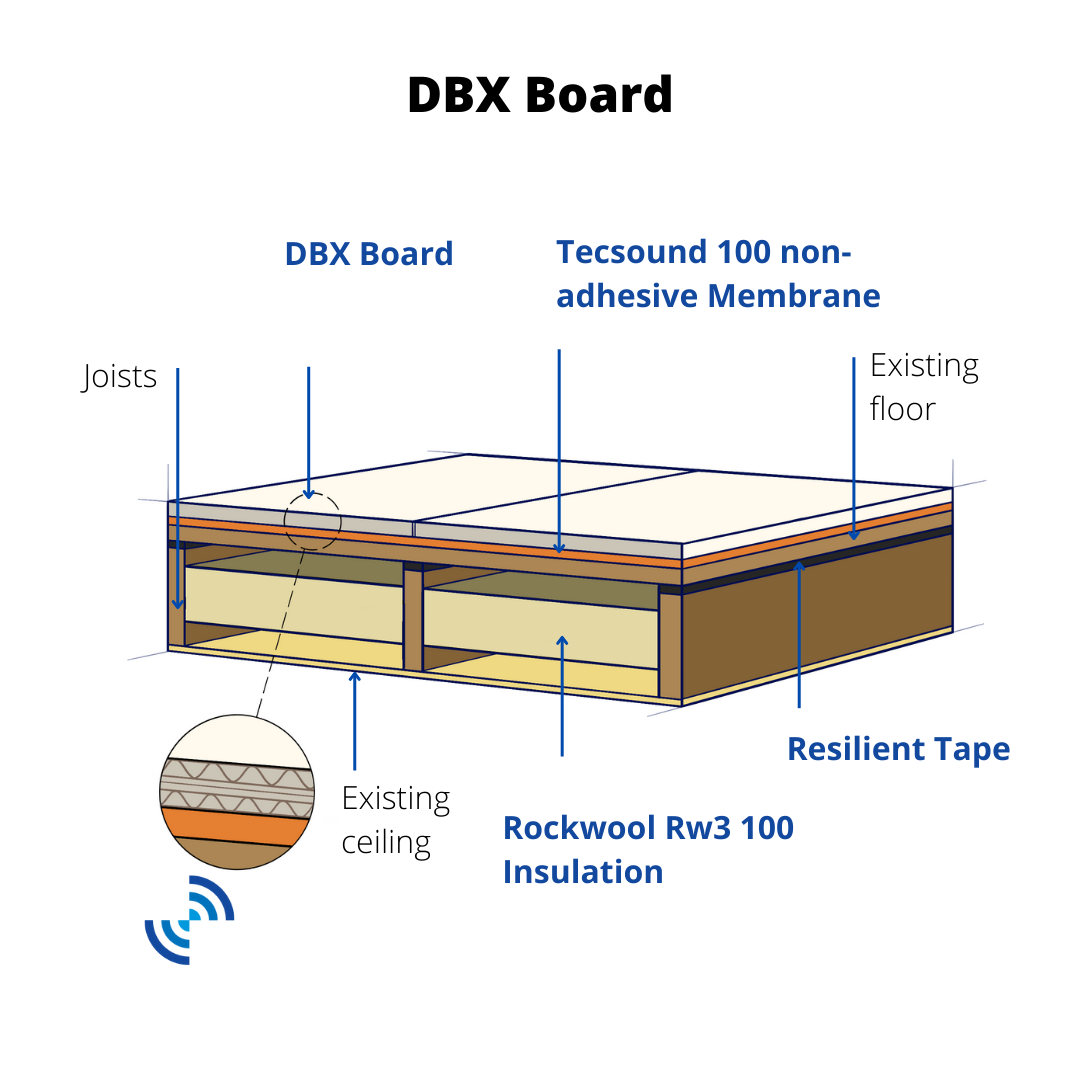
The DBX Board floor solution is best suited for reducing airborne noise between floors, especially when you want to improve sound insulation without lifting the existing floorboards.

Yes. This is one of the strongest floor options for reducing airborne noise such as voices, TV, music and general room-to-room sound transfer through the floor structure.

This system includes 15mm DBx PRO Acoustic Board, Tecsound 100 acoustic membrane, Rockwool RW3 acoustic mineral wool and resilient tape to help reduce flanking noise and vibration transfer.

The DBX Board system is designed to be easier to fit because it can be installed over the existing floor deck. However, if you are adding acoustic mineral wool between joists, access to the floor cavity will still be required.

It can help reduce some impact noise, but its main strength is airborne noise reduction. If impact noise such as footsteps is the main issue, an acoustic barrier mat or impact mat system may be more suitable.

DBX Board uses a dense, loose-filled core that helps disrupt sound energy more effectively than simply adding another solid board layer. This makes it useful where airborne sound reduction is the priority.

View solution & calculate costs

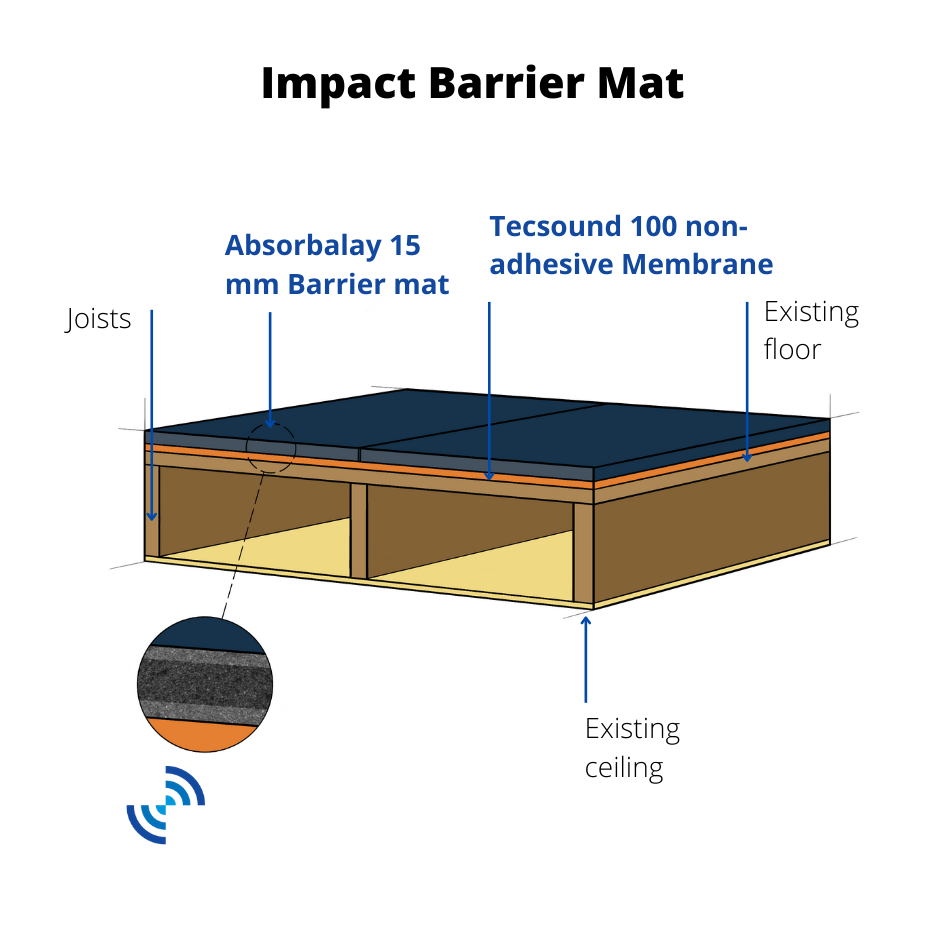
This solution is best for reducing impact noise through floors, such as footsteps, movement, dropped items and general footfall noise travelling into the room below.

It works by combining acoustic mass with a resilient floor layer. The mat helps absorb and reduce impact vibration, while the Tecsound membrane adds mass to help reduce sound transfer through the floor.

This option uses Tecsound 100 Non-Adhesive Membrane and Absorbalay 15 to create a floor build-up focused on impact noise reduction and improved acoustic performance.

Yes. This type of system is commonly used beneath carpet and underlay where reducing impact noise is the main aim. The soft floor finish also helps improve the overall impact noise performance.

It can help reduce some airborne noise because the membrane and mat add mass to the floor. However, if airborne noise is the main issue, the DBX Board system may be the stronger option.

Yes. It is a practical option for upstairs rooms, flats and shared buildings where impact noise from footfall is causing disturbance to the space below.

View solution & calculate costs

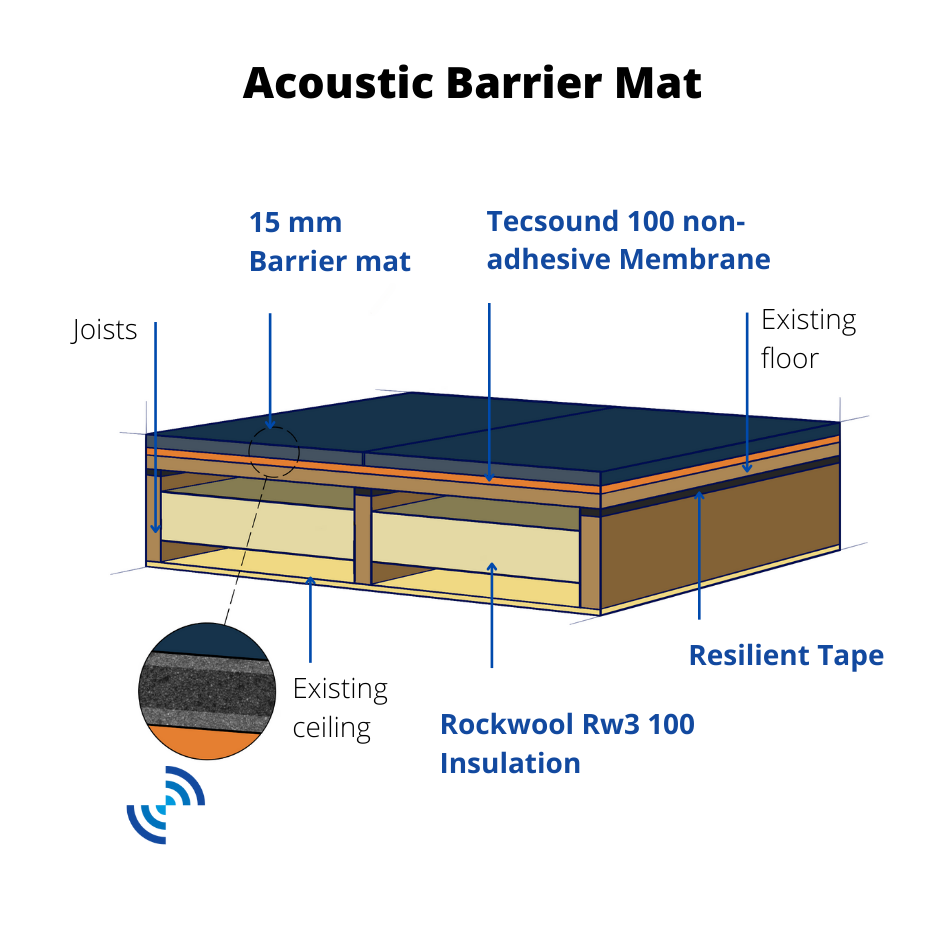
This solution is designed for improving floor soundproofing where impact noise is the main concern, but where you also want to improve airborne noise reduction by adding mass and acoustic insulation.

This option combines Rockwool RW3 acoustic mineral wool, resilient tape, Tecsound 100 Non-Adhesive Membrane and Absorbalay 15 to improve both impact and airborne sound reduction through the floor.

Absorbalay 15 adds resilience to the floor, helping reduce footfall and movement noise. This is supported by the extra mass from the Tecsound membrane and the absorption provided by Rockwool RW3 within the floor cavity.

Rockwool RW3 is used between the floor joists to absorb sound energy inside the cavity. This helps reduce resonance and improves the airborne performance of the overall floor system.

Yes. Adding acoustic mineral wool, resilient tape and Tecsound membrane creates a more complete floor soundproofing build-up than a mat-only solution. This is useful where both impact and airborne sound need to be improved.

This system is useful in bedrooms, flats, hallways, stairs, offices and other high-traffic areas where footfall noise and sound transfer through the floor are both a concern.

View solution & calculate costs

Need help with your soundproofing?

Our team are on hand to answer any questions and give you all the advice you need.

Contact us

How do our floor soundproofing solutions work?

Our floor soundproofing solutions work by combining different acoustic materials to reduce sound travelling between floors. Depending on the system, this can include acoustic boards, acoustic membranes, barrier mats, resilient layers, acoustic mineral wool and perimeter isolation products.

Each material has a specific purpose. Dense acoustic materials help block airborne noise, such as voices, TV and music. Resilient layers help reduce impact noise, such as footsteps, movement and dropped items. Acoustic insulation helps absorb sound energy within the floor cavity and reduce resonance between joists.

Some floor soundproofing systems are designed to be installed over the existing floor deck, making them useful when you do not want to lift the floorboards. Other systems include acoustic mineral wool between the joists for a more complete floor build-up, especially where airborne noise is also a concern.

Our floor soundproofing solutions can be used in a wide range of residential and commercial settings, including flats, bedrooms, home offices, studios, treatment rooms, rental properties, shared buildings and high-traffic areas.

To make ordering easier, our floor soundproofing systems can be calculated based on your room dimensions. This helps you choose the right products, quantities and upgrades for your floor type, noise issue and budget.

What are the benefits of floor soundproofing?

Floor soundproofing offers several benefits for homes, flats, apartments and commercial spaces. The main benefit is reducing unwanted noise travelling between levels of a building, helping to create a quieter and more comfortable environment.

For homes and flats, floor soundproofing can help reduce footstep noise, movement noise, voices, TV sound, music and general disturbance between floors. For commercial spaces, it can help improve privacy, reduce distractions and make rooms more suitable for work, meetings, treatments or specialist use.

  • Reduced impact noise: Helps reduce footsteps, dropped items, furniture movement and general vibration through the floor.
  • Improved airborne sound reduction: Helps reduce voices, TV, music and general noise passing between floors.
  • Better privacy: Makes it harder for sound to travel between rooms and levels.
  • Improved comfort: A quieter floor can make bedrooms, living spaces and offices more relaxing and usable.
  • Useful for flats and shared buildings: Floor soundproofing can help reduce disturbance between neighbouring properties.
  • Flexible system options: Different solutions are available depending on floor type, access, floor finish and performance requirements.

The best results usually come from choosing a system that matches the type of noise you are dealing with, the existing floor construction and the final floor finish.

What should you consider when choosing a floor soundproofing solution?

When choosing a floor soundproofing solution, the first thing to consider is the type of noise you need to reduce. Impact noise and airborne noise are different problems, and they often require different acoustic materials.

Impact noise is caused by direct contact with the floor. This includes footsteps, movement, dropped objects and furniture being moved. To reduce impact noise, the floor usually needs a resilient acoustic layer that can absorb vibration before it passes into the structure below.

Airborne noise includes voices, TV, music and general sound travelling through the floor. To reduce airborne noise, the floor system usually needs more acoustic mass, better sealing and, where possible, acoustic insulation within the floor cavity.

You should also consider whether the floorboards can be lifted. If you can access the space between the joists, acoustic mineral wool can be installed to improve the performance of the floor. If the floor cannot be lifted, an over-floor system may be more suitable.

The final floor finish is also important. Carpet and underlay can help with impact noise, while hard flooring normally needs a suitable acoustic layer underneath to reduce footfall and vibration transfer.

Finally, think about the depth of the system, installation requirements and budget. Some floor soundproofing solutions are simpler to install, while others provide a more complete acoustic build-up for higher performance.

How do you soundproof a floor?

Soundproofing a floor usually involves combining several acoustic methods together. The right method depends on whether you are treating impact noise, airborne noise or both.

The steps below explain the main principles used in effective floor soundproofing.

1. Identify the type of noise

Before choosing a system, it is important to identify whether the problem is impact noise, airborne noise or a combination of both. Footsteps and movement usually require resilient layers, while voices, TV and music usually require mass and insulation.

2. Add acoustic mass

Dense materials help block airborne sound. Acoustic boards and soundproofing membranes can be used to increase the mass of the floor structure, making it harder for sound to pass between levels.

3. Use resilient floor layers

Resilient mats and barrier layers help reduce impact vibration from footsteps and movement. These layers create a softer acoustic break between the floor finish and the structure below.

4. Add acoustic insulation between joists

Where the floor cavity can be accessed, acoustic mineral wool can be installed between the joists. This helps absorb sound energy inside the void and improves airborne noise reduction through the floor.

5. Seal gaps and weak points

Small gaps between floorboards, around edges or where pipes and services pass through can allow sound to leak through. Sealing these weak points helps the full floor soundproofing system perform more effectively.

6. Reduce flanking noise

Sound does not always travel directly through the centre of the floor. It can also travel around the edges, through walls, joists, skirting areas and connected structures. Resilient tape, careful edge detailing and proper sealing can help reduce these flanking paths.

7. Choose the right floor finish

The floor finish can affect the final performance. Carpet and underlay are usually better for impact noise than hard flooring. If you are installing hard flooring, it is important to use a suitable acoustic layer underneath.

If you are unsure which option is right for your project, our team can help you compare the available floor soundproofing solutions and choose a system that suits your floor type, noise problem, budget and installation requirements.

Not found the solution you need yet?

Get 10% Off Your First Order

Sign up today and we’ll send your discount code straight to your inbox.