Space Saving System for Solid Walls
- A slim wall soundproofing system for solid party walls
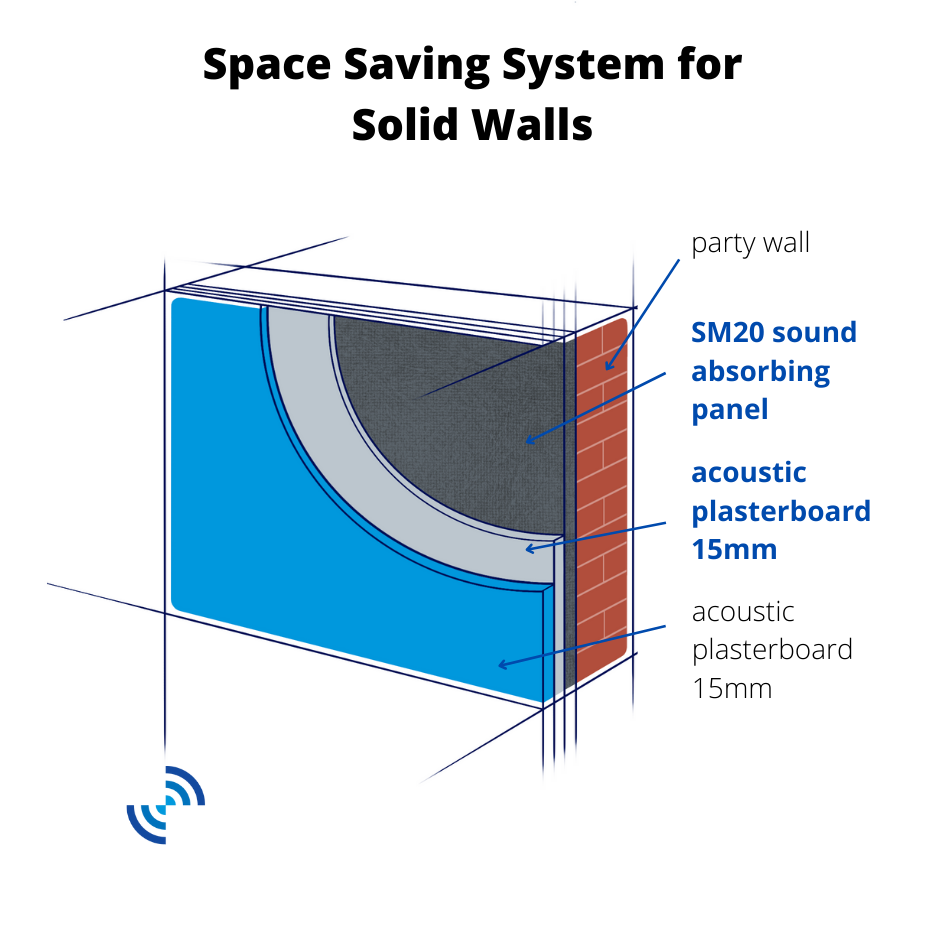
- Uses SM20 sound absorbing panels with two layers of 15mm dB Board
- Designed for rooms where wall depth needs to be kept to a minimum


Designed for solid walls
Minimal wall depth gain
No independent stud frame required
This system is ideal where space is limited and you need a direct-to-wall soundproofing solution.
SM20 sound absorbing panel
Designed to improve wall performance
Suitable for solid party walls
The SM20 layer helps reduce sound transfer while keeping the overall wall build-up relatively compact.
Two layers of 15mm dB Board
Acoustic sealant around perimeters
Added mass for airborne noise reduction
The double plasterboard layer helps add mass to the system, improving the wall’s ability to reduce airborne sound.
Acoustic performance can vary depending on the existing wall construction, flanking paths, gaps, socket positions and installation quality. For best results, the boards should be fitted tightly and all perimeter gaps should be sealed carefully with acoustic sealant.
The Space Saving System for Solid Walls is designed to improve sound reduction without building a deep independent stud wall. It uses SM20 sound absorbing panels fixed to the existing solid wall, followed by two layers of 15mm dB Board.
The SM20 panel helps absorb and control sound energy at the wall surface, while the double board finish adds mass. This combination is useful for reducing airborne noise such as voices, TV noise and general neighbour noise through solid party walls.
Acoustic sealant is used around the perimeter to help close small gaps where sound can otherwise leak through.
This system can be upgraded by reviewing other weak points in the room, such as sockets, floors, ceilings, doors and flanking walls. A wall system will only perform properly if the surrounding sound paths are also controlled.
For higher performance, you may need to consider an independent stud wall system instead. Independent systems usually take up more space, but they can offer stronger separation from the original wall structure.
This solution is suitable for solid party walls where space is limited and a slimmer direct-to-wall system is preferred. It can be used in bedrooms, living rooms, home offices, rental properties, flats and other spaces affected by neighbour noise.
It is best suited to airborne noise problems. If the noise is mainly vibration, impact noise or structure-borne sound, floors and ceilings may also need to be considered.
Start by checking the wall surface is clean, stable and suitable for the system. Any loose material, large gaps, cracks or damaged areas should be dealt with before the acoustic layers are fitted.
Install the SM20 sound absorbing panels to the existing solid wall, keeping joints tight and avoiding unnecessary gaps. Fit the first layer of 15mm dB Board over the panels, then install the second 15mm dB Board layer with staggered joints where possible.
Seal all perimeters and junctions with acoustic sealant. Pay close attention to sockets, edges, skirting lines and any wall penetrations, as small gaps can reduce the performance of the system.
Our team are on hand to answer any questions and help you choose the right wall soundproofing system.
Contact usSound can travel through floor structures, especially in flats, bedrooms and rooms above or below occupied spaces. Floor soundproofing can help reduce impact noise, footsteps and airborne sound transfer.
If noise is travelling from above or below, the ceiling may also need treatment. Ceiling systems can help reduce airborne sound, vibration and impact noise through the floor-ceiling structure.
It is a slim wall soundproofing system for solid walls, using SM20 sound absorbing panels and two layers of 15mm dB Board.
It is designed for projects where you want to improve wall soundproofing without building a deep independent stud wall.
This system is mainly designed to help reduce airborne noise through solid walls, such as voices, TV noise, music and general neighbour noise.
If the noise is caused by vibration or impact through the building structure, you may also need to consider floors, ceilings or other flanking paths.
Yes, this system is designed to keep the wall build-up as compact as possible.
It will still add some depth to the wall, but it is slimmer than an independent stud wall system.
The two board layers add mass to the wall, which helps reduce airborne sound transfer.
Staggering the joints between layers can also help reduce weak points in the finished acoustic wall build-up.
Yes, acoustic sealant is important because small gaps around the perimeter can allow sound to leak through.
Use it around edges, junctions and any areas where the system meets adjoining surfaces.
Not necessarily. This system is slimmer, but an independent stud wall can offer stronger separation from the original wall structure.
The best option depends on your available space, noise problem and performance requirements.


Sign up today and we’ll send your discount code straight to your inbox.