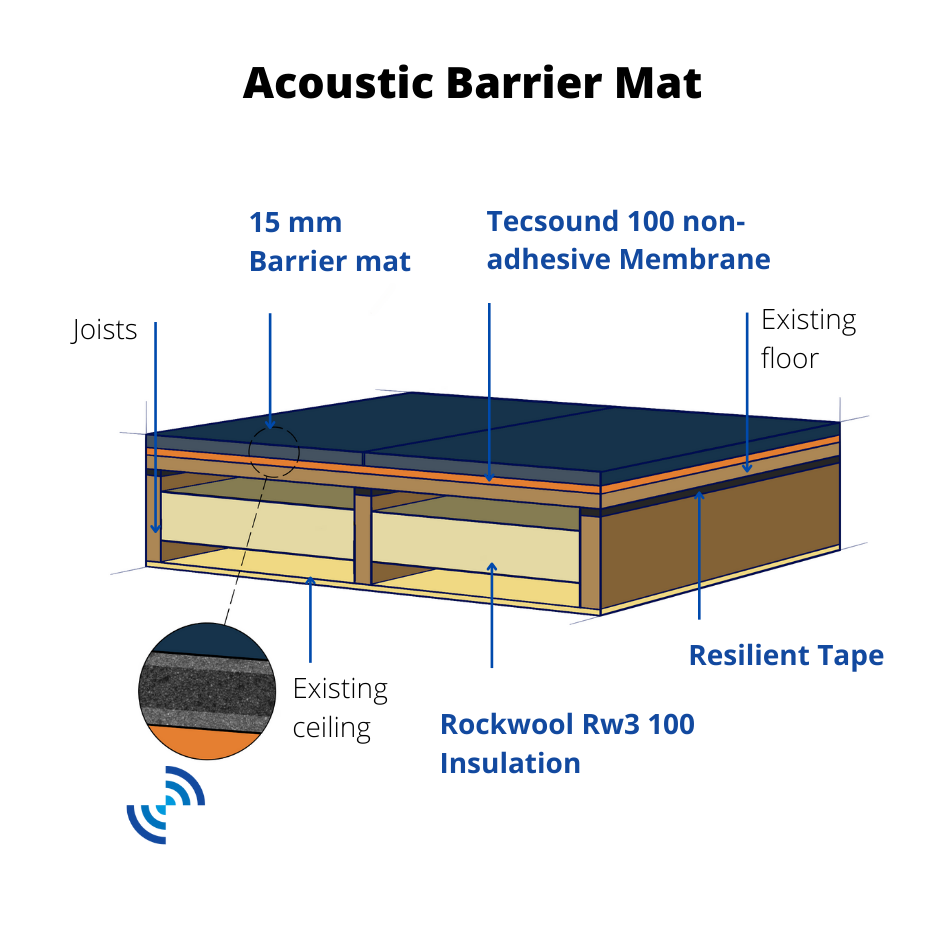
The Acoustic Barrier Mat system works by treating both the floor surface and the cavity below. Rockwool RW3 100mm is fitted between the joists to help absorb sound inside the floor void and reduce resonance within the timber structure.
Tecsound 100 Non-Adhesive Membrane is then used as a dense acoustic layer over the existing floor. This adds mass to the floor build-up, helping reduce airborne sound transfer.
Absorbalay 15 is installed as the upper barrier mat layer to help reduce impact noise such as footsteps, movement and vibration. Resilient Tape 50mm is used around key contact points and perimeters to help reduce rigid connections.
This system can be upgraded by treating the ceiling below, especially where noise is travelling through the full floor and ceiling structure.
For stronger airborne noise or impact noise issues, combining this floor system with a resilient bar or resilient clip ceiling system below may improve the overall result.
It is also worth reviewing flanking paths such as surrounding walls, gaps around pipework, skirting lines and structural junctions, as sound can bypass the main floor build-up through these weak points.
The Acoustic Barrier Mat system is suitable for timber floors where both the floor void and floor surface can be treated. It is commonly used in flats, bedrooms, living rooms, rental properties, offices and spaces where noise is travelling between floors.
It is a good option when you want more than a simple overlay mat, because the system also includes acoustic insulation between the joists.
Start by exposing the floor area and checking the condition of the existing floorboards or deck. If the floor void is accessible, fit Rockwool RW3 100mm neatly between the joists, avoiding gaps and over-compression.
Lay the Tecsound 100 Non-Adhesive Membrane over the existing floor surface, keeping joints tight. Use Resilient Tape 50mm around the perimeter and key contact points where required.
Install the Absorbalay 15 barrier mat over the membrane, keeping edges neat and avoiding unnecessary gaps. The final floor finish should then be installed in line with the flooring manufacturer’s guidance.