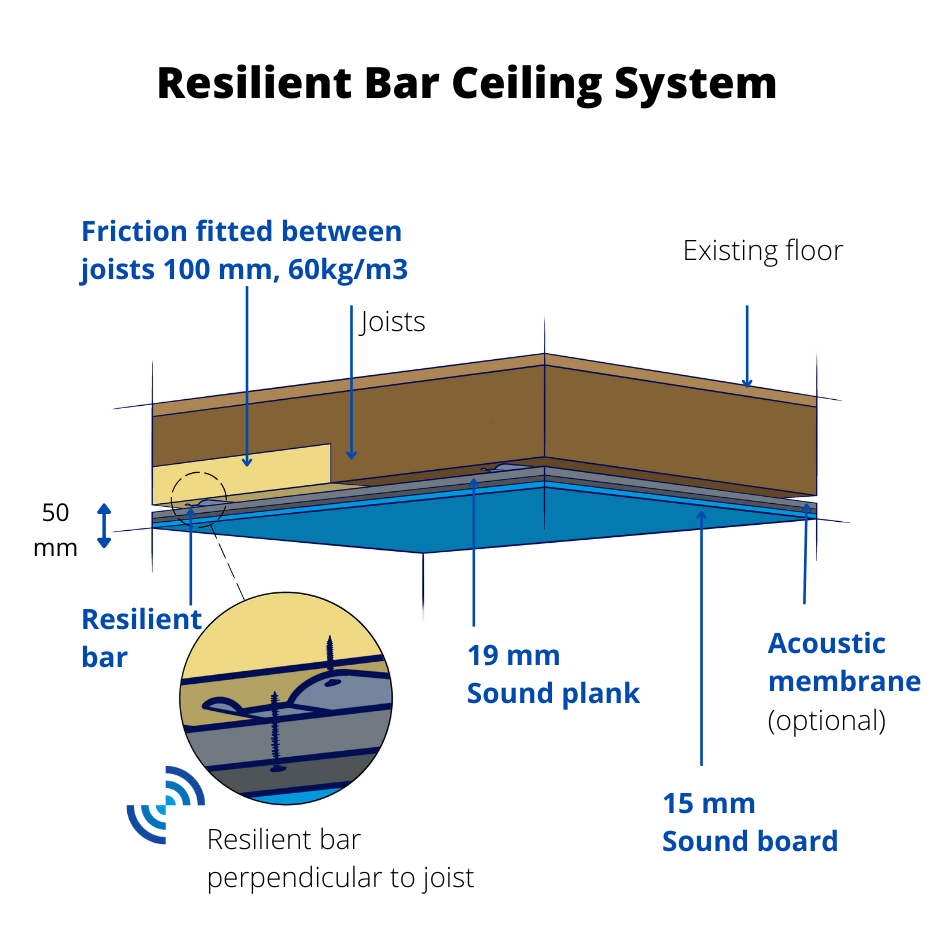
The Resilient Bar Ceiling System works by adding acoustic absorption, isolation and mass to an existing timber joist ceiling. Rockwool RW3 100mm is friction fitted between the joists to help absorb sound inside the ceiling void.
Resilient bars are then fixed perpendicular to the joists. These bars create a flexible mounting point for the acoustic board layers, helping reduce the amount of vibration passing directly from the joists into the new ceiling surface.
The 19mm Acoustic Plank and 15mm dB Board add mass to the ceiling. The optional Tecsound membrane can be installed between the board layers for extra acoustic density where higher performance is needed.
This ceiling system can be upgraded by including the Tecsound 50SY self-adhesive membrane between the 19mm Acoustic Plank and the 15mm dB Board. This adds extra mass without dramatically increasing the total ceiling depth.
For stronger impact noise issues, it may also be worth treating the floor above with a suitable floor soundproofing system. Ceiling systems are effective, but impact noise can often benefit from treatment at the source as well as below.
This solution is suitable for ceilings below bedrooms, flats, offices, living spaces and other rooms where noise is travelling from the floor above.
It can help reduce airborne noise such as voices, TV and music, while also helping with some vibration transfer through the joist structure. For heavier footstep noise, combining ceiling treatment with floor treatment above may provide better results.
Start by preparing the ceiling area and checking the joist structure. Fit Rockwool RW3 100mm neatly between the joists, avoiding gaps and over-compression.
Fix the resilient bars perpendicular to the joists, following the correct spacing and orientation. The acoustic board layers should be fixed to the resilient bars, not directly into the joists. Install the 19mm Acoustic Plank first, then apply the optional Tecsound membrane if required, before finishing with the 15mm dB Board.
Seal the perimeter carefully with acoustic sealant. Avoid rigid bridging around the ceiling edges, light fittings, pipework or other penetrations, as these can reduce the acoustic performance of the system.