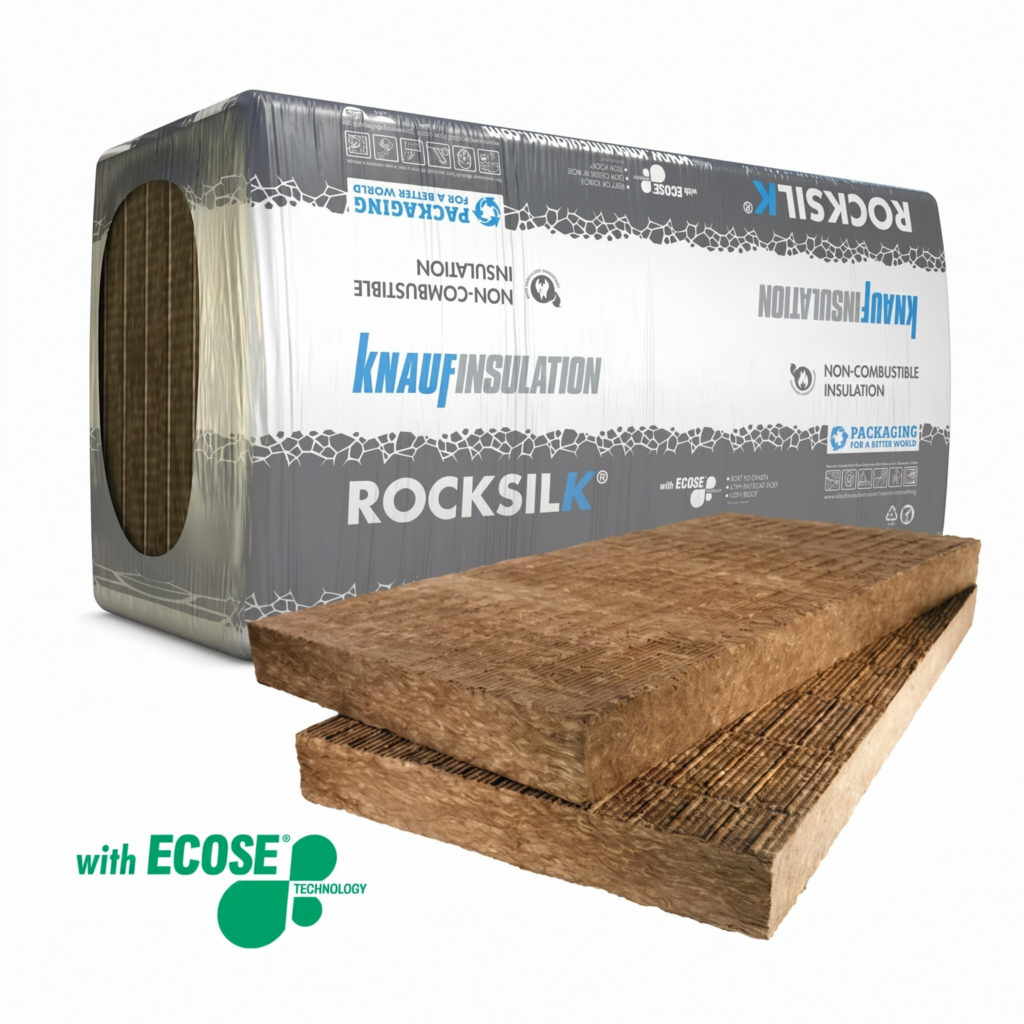
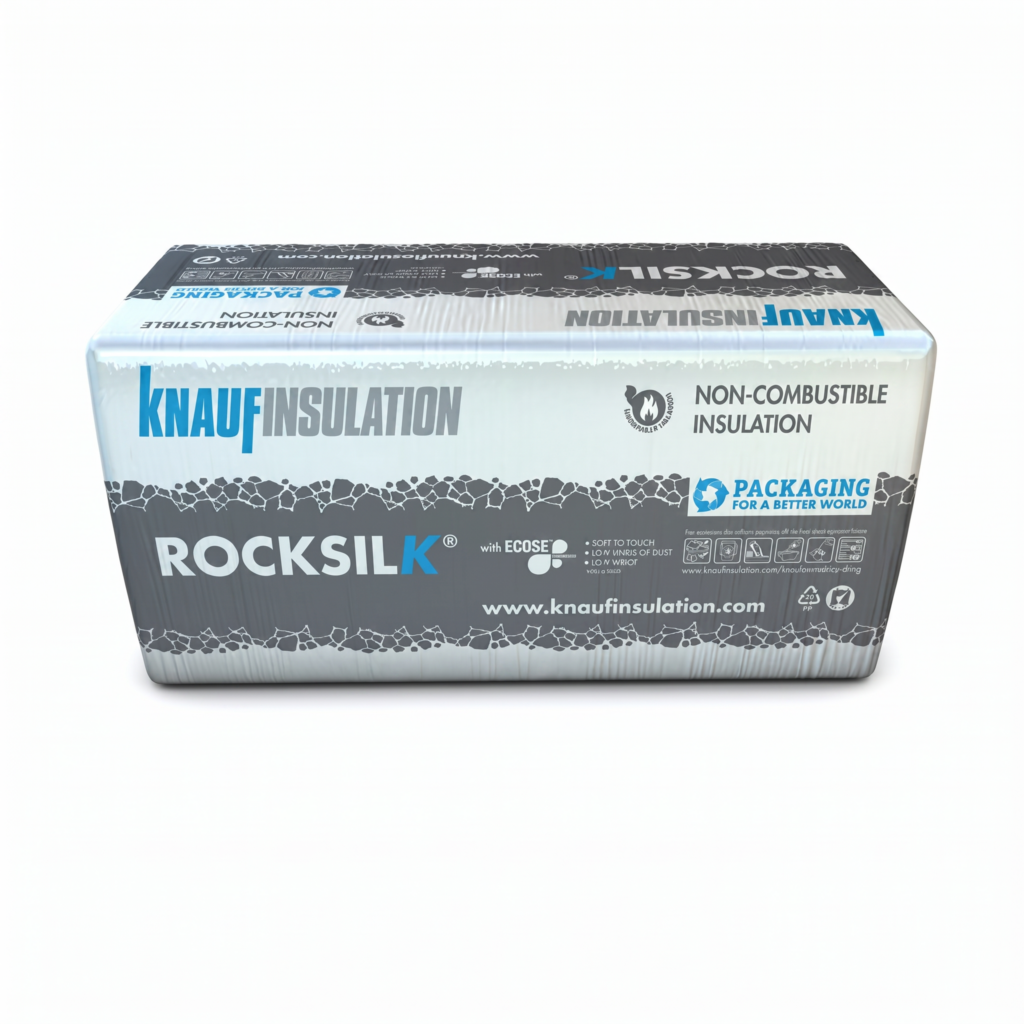
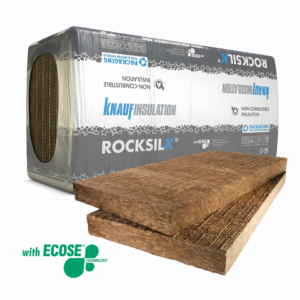
Knauf Rocksilk RS100 Acoustic Mineral Wool
Knauf Rocksilk RS100 Acoustic Mineral Wool is a high-density 100kg/m³ rock mineral wool insulation slab used for acoustic, thermal and fire protection applications. It is suitable for use in walls, floors, ceilings, internal partitions, separating floors, fabrication work and specialist acoustic build-ups where a denser mineral wool slab is required.
This variable product is available in 50mm, 75mm and 100mm thicknesses, allowing you to choose the correct slab depth for your wall, floor or ceiling cavity.
What is Knauf Rocksilk RS100 used for?
Knauf Rocksilk RS100 is used to provide high-density mineral wool infill within building cavities and acoustic systems. It can help absorb sound energy inside wall, floor and ceiling voids, while also supporting thermal and fire performance.
It is commonly used where density and mechanical characteristics are important, including specialist fire protection, fabrication work, acoustic partitions, separating floors and higher-density insulation applications.
How does Rocksilk RS100 help with soundproofing?
Rocksilk RS100 helps absorb sound energy within cavities. Empty cavities can resonate and allow sound to pass through more easily. Installing mineral wool inside the cavity helps reduce this resonance and supports the performance of the complete soundproofing system.
RS100 is not a standalone soundproofing barrier. It should be combined with suitable board mass, acoustic plasterboard, resilient bars, Genie Clips, MuteClips, acoustic membranes, acoustic sealant and correct perimeter detailing where required.
Available thicknesses
- 50mm — suitable for slimmer high-density acoustic cavities and specialist insulation details.
- 75mm — suitable for medium-depth wall, floor and ceiling cavities.
- 100mm — suitable for deeper cavities where a thicker high-density mineral wool slab is required.
RS100 vs RS60 and RS45 — what is the difference?
RS100 is denser than both RS45 and RS60. RS45 is a 45kg/m³ slab, RS60 is a 60kg/m³ slab, and RS100 is a 100kg/m³ slab.
A higher-density slab is not automatically the right choice for every acoustic cavity. The correct product depends on the system design, cavity depth, required density, fire requirement, mechanical requirement and project specification.
For many standard wall and ceiling cavities, RS45 or RS60 may be suitable. RS100 is typically selected where a denser, more specialist slab is required.
Where can Knauf Rocksilk RS100 be used?
Knauf Rocksilk RS100 can be used in a range of acoustic and insulation applications, including:
- Internal walls and partitions
- Party wall soundproofing systems
- Separating floors
- Internal floors
- Ceiling soundproofing systems
- Timber frame walls
- Light steel frame walls
- Pitched roofs at rafter level
- Specialist fabrication work
- Passive fire protection applications
- Studios, media rooms and music rooms
- Commercial acoustic partitions and fit-outs
Why choose Knauf Rocksilk RS100?
Knauf Rocksilk RS100 is a high-density mineral wool slab that offers acoustic absorption, thermal insulation and Euroclass A1 non-combustible fire performance in one product.
The slabs are easy to cut and friction fit between framing members. The 1200mm x 600mm slab size makes them practical for common wall, floor, roof and ceiling applications.
Key benefits
- 100kg/m³ density — high-density rock mineral wool slab for specialist applications.
- Acoustic absorption — helps reduce cavity resonance within walls, floors and ceilings.
- Rock mineral wool construction — suitable for acoustic, thermal and fire protection applications.
- Euroclass A1 non-combustible — excellent reaction to fire classification.
- 0.034 W/mK declared thermal conductivity — supports thermal insulation performance.
- Available in 50mm, 75mm and 100mm — choose the correct thickness for your cavity depth.
- 1200mm x 600mm slabs — practical format for wall, floor and ceiling installation.
- Manufactured with ECOSE® Technology — Knauf’s bio-based binder technology.
- Suitable for specialist applications — useful where density and mechanical characteristics are important.
- Works within full soundproofing systems — suitable for use with acoustic boards, clips, channels and sealants.
Helpful advice before buying
Choose the thickness based on the depth of your cavity and the system specification. The slab should fit neatly without being heavily compressed.
For soundproofing projects, RS100 should normally be used with additional mass, decoupling and airtight sealing. Mineral wool alone will not fully soundproof a wall, floor or ceiling.
If you are unsure whether RS100 is the right density for your project, please contact our team before ordering. We can help advise on the most suitable acoustic build-up for your wall, floor or ceiling system.
Knauf Rocksilk RS100 Acoustic Mineral Wool Technical Specifications
Knauf Rocksilk RS100 Acoustic Mineral Wool is a high-density 100kg/m³ rock mineral wool slab used in acoustic, thermal and fire protection applications. It is suitable for internal walls, partitions, floors, ceilings, separating floors, light steel frame walls, timber frame walls and specialist fabrication work.
Product Specification
| Product Name |
Knauf Rocksilk RS100 Acoustic Mineral Wool |
| Brand |
Knauf Insulation |
| Product Type |
High-density rock mineral wool insulation slab |
| Application |
Acoustic, thermal and fire protection insulation |
| Material |
Rock mineral wool |
| Density |
100kg/m³ |
| Thermal Conductivity |
0.034 W/mK |
| Reaction to Fire |
Euroclass A1 non-combustible |
| Binder Technology |
ECOSE® Technology |
| Slab Size |
1200mm x 600mm |
| Area Per Slab |
0.72m² |
| Available Thicknesses |
50mm, 75mm and 100mm |
| Facing |
Unfaced slab, unless otherwise stated |
| Main Acoustic Function |
Sound absorption within wall, ceiling and floor cavities |
| Standalone Soundproofing Product? |
No — should be used as part of a complete acoustic system |
Thickness and Pack Coverage
| Thickness |
Slab Size |
Slabs Per Pack |
Pack Coverage |
Declared R-Value |
| 50mm |
1200mm x 600mm |
6 slabs |
4.32m² |
1.45 m²K/W |
| 75mm |
1200mm x 600mm |
4 slabs |
2.88m² |
2.20 m²K/W |
| 100mm |
1200mm x 600mm |
3 slabs |
2.16m² |
2.90 m²K/W |
Suitable Applications
Knauf Rocksilk RS100 can be used in a range of applications, including:
- Internal walls and partitions
- Timber stud walls
- Metal stud walls
- Party wall soundproofing systems
- Ceiling soundproofing systems
- Floor and ceiling voids
- Internal floors
- Separating floors
- Ground floors
- Pitched roofs at rafter level
- Light steel frame walls
- Timber frame walls
- Fabrication work
- Passive fire protection applications
- Commercial acoustic partitions
Acoustic Use
Rocksilk RS100 is used to absorb sound inside cavities. It is normally installed between studs, joists or frame members before the plasterboard or acoustic board layers are fitted.
It helps reduce cavity resonance and supports the performance of the complete soundproofing system. It should be combined with appropriate mass, decoupling and airtight sealing for best acoustic results.
Common Soundproofing System Uses
- Between studs in acoustic wall systems
- Between joists in ceiling soundproofing systems
- Inside independent wall frames
- Inside MuteClip or Genie Clip wall/ceiling systems
- Behind acoustic plasterboard and soundproofing boards
- Within timber floor voids to reduce resonance
- Within music room, cinema room and studio build-ups
- Within commercial partition and office acoustic systems
- Within specialist high-density acoustic or fire protection details
RS100 Thickness Guide
- 50mm RS100 — useful where a high-density slab is required but the cavity depth is limited.
- 75mm RS100 — useful for medium-depth cavities requiring a denser mineral wool infill.
- 100mm RS100 — useful for deeper cavities where a thick high-density slab can be fitted.
Important Performance Note
Knauf Rocksilk RS100 is an acoustic insulation slab, not a complete soundproofing system on its own.
The final acoustic result will depend on the full wall, floor or ceiling construction, including the existing structure, cavity depth, board mass, decoupling method, perimeter sealing, workmanship and flanking noise paths.
For Building Regulations, fire-rated or compliance-led projects, use the correct tested system specification and seek project-specific advice where required.
Handling Advice
Store packs clean, dry and protected before installation. Do not leave mineral wool exposed to weather or standing water.
Wear suitable PPE when cutting and installing mineral wool, including gloves, long sleeves, eye protection and a dust mask. Cut slabs with a sharp insulation knife or suitable saw.
How to Install Knauf Rocksilk RS100 Acoustic Mineral Wool
Knauf Rocksilk RS100 Acoustic Mineral Wool is installed within wall, floor and ceiling cavities to provide acoustic absorption, thermal insulation and fire protection support.
For acoustic projects, it should be installed neatly between studs, joists or framing members without gaps, heavy compression or rigid bridging.
What You’ll Need
- Knauf Rocksilk RS100 Acoustic Mineral Wool
- Correct thickness: 50mm, 75mm or 100mm
- Tape measure
- Pencil or marker
- Insulation knife or suitable saw
- Straight edge or cutting board
- Gloves
- Long sleeves
- Safety glasses
- Dust mask
- Waste bag for offcuts
- Acoustic sealant, where required
- Retention netting or wire support, where required for ceiling or floor voids
Before You Start
Choose the correct thickness for your cavity depth and system specification. RS100 is a high-density slab, so make sure the chosen thickness is suitable for the available space and the intended build-up.
Check the installation area before fitting. The cavity should be clean, dry and free from loose debris, sharp fixings and obvious gaps.
For soundproofing systems, plan the complete build-up before installing the mineral wool. This may include acoustic plasterboard, resilient bars, Genie Clips, MuteClips, acoustic membranes and acoustic sealant.
Step 1: Measure the Cavity
Measure the distance between the studs, joists or frame members.
Take measurements at several points because older buildings and timber frames are not always perfectly even.
For a neat friction fit, the slab can usually be cut slightly wider than the cavity, but it should not be forced in so tightly that it becomes heavily compressed.
Step 2: Cut the Slabs to Size
Place the Rocksilk RS100 slab on a stable cutting surface.
Use a sharp insulation knife or suitable saw to cut the slab to the required size. Cut cleanly and avoid tearing the edges.
Where possible, cut pieces so they fit tightly around studs, joists, noggins and services without leaving open gaps.
Step 3: Fit the Mineral Wool into the Cavity
Push the slab gently into the cavity so it sits flush with the framing.
The insulation should fill the cavity evenly. Avoid leaving air gaps, voids or loose edges.
Do not heavily compress the mineral wool. Heavy compression can reduce its ability to absorb sound within the cavity and may make the board layers harder to install correctly.
Step 4: Deal with Services and Obstructions
Cut neatly around pipes, cables, sockets, noggins and other obstructions.
Do not leave large holes around services. Small gaps can reduce the overall acoustic performance of the system.
Where services pass through the wall, ceiling or floor, use suitable acoustic sealant or approved fire/acoustic detailing as required by the project.
Step 5: Install Between Wall Studs
For wall installations, fit the Rocksilk RS100 between timber or metal studs before installing the plasterboard or acoustic board layers.
Make sure the slabs are supported by the studs and sit flat within the cavity.
For acoustic walls, the mineral wool should normally be combined with suitable board mass and airtight perimeter sealing.
Step 6: Install Between Ceiling Joists
For ceiling soundproofing systems, fit the Rocksilk RS100 between the ceiling joists.
If the ceiling is open from below, friction fit the slabs between the joists or use suitable retention netting where required.
Make sure the mineral wool does not drop, sag or leave open gaps before the ceiling board layers are installed.
Step 7: Install Between Floor Joists
For timber floor voids, fit the Rocksilk RS100 between the floor joists to reduce cavity resonance.
Where needed, support the insulation with netting, wire or suitable support battens so it remains in position.
Do not use RS100 as a load-bearing floating floor resilient layer unless it has been specifically specified for that purpose. It is normally used within the cavity rather than as a compressed layer beneath a floating deck.
Step 8: Maintain Acoustic Separation
If the mineral wool is being used in a decoupled system, make sure it does not create rigid bridges between isolated layers.
The insulation should sit within the cavity and should not be packed so tightly that it forces isolated boards, clips, channels or frames out of position.
Step 9: Install the Board Layers
Once the Rocksilk RS100 is fitted, install the specified plasterboard, acoustic plasterboard or soundproofing board layers.
Follow the board manufacturer’s fixing guidance. In clip and channel systems, only fix boards into the channel and avoid fixing through into the structure behind.
For high-performance acoustic systems, stagger board joints between layers and use acoustic sealant around perimeters.
Step 10: Seal Gaps and Perimeters
After the board layers are installed, seal perimeter gaps, service penetrations and small openings with suitable acoustic sealant.
Pay attention to:
- Wall-to-floor junctions
- Wall-to-ceiling junctions
- Board perimeters
- Socket boxes
- Pipe penetrations
- Cable penetrations
- Gaps around skirting or trim
Good airtightness is essential because sound can pass through small gaps.
Installation Tips
- Choose the correct thickness for the cavity depth and system specification.
- Use 50mm for shallow cavities, 75mm for medium cavities and 100mm for deeper cavities.
- Do not assume higher density is automatically better for every acoustic system.
- Cut slabs neatly for a close friction fit.
- Do not leave open gaps inside the cavity.
- Do not heavily compress the mineral wool.
- Use retention support where insulation may sag or fall.
- Wear gloves, long sleeves, eye protection and a dust mask during installation.
- Keep packs dry before installation.
- Use acoustic sealant around gaps, edges and penetrations.
- Combine with suitable board mass and decoupling for soundproofing projects.
- Do not rely on mineral wool alone as a complete soundproofing system.
Important Soundproofing Note
Knauf Rocksilk RS100 Acoustic Mineral Wool helps absorb sound within cavities, but it does not block sound by itself.
The final performance depends on the complete wall, floor or ceiling build-up, including existing structure, board mass, decoupling method, acoustic sealing, workmanship and flanking paths.
If you are unsure which thickness or density is right for your project, please contact our team before installation. We can help advise on the most suitable acoustic build-up for your wall, ceiling or floor.